7 Best Exercises for Better Sleep
Millions of adults lie awake every night unable to switch off. They try melatonin, white noise machines, and blackout curtains but skip the one lifestyle change that research consistently backs. That change is regular exercise.
The right exercise at the right time does not just tire your body out. It lowers cortisol, regulates your circadian rhythm, and triggers neurochemical changes that make falling and staying asleep significantly easier. As an MBBS doctor, I recommend exercise as a first-line approach for every patient who comes to me with poor sleep.
Table of Contents
Why Sleep Deprivation Is a Medical Problem
Sleep is not passive rest. Your body uses it to repair tissue, consolidate memory, regulate blood sugar, and reset hormonal balance.
When sleep quality drops consistently, the effects are serious. Poor sleep is independently linked to obesity, type 2 diabetes, cardiovascular disease, and weakened immunity.
The cognitive damage is just as real. Concentration, reaction time, and decision-making all deteriorate significantly with even one week of insufficient sleep.
How a Sedentary Lifestyle Disrupts Your Sleep
Without regular physical activity, your body struggles to build the sleep pressure it needs to fall asleep naturally. Stress hormones like cortisol stay elevated all day because there is no physical outlet to burn them off.
Your circadian rhythm also weakens without movement. Light physical activity during the day is one of its key regulators, and skipping it makes your body less able to distinguish between wake time and sleep time.
Common Mistakes People Make With Exercise and Sleep
Most people either avoid exercise entirely or do it in ways that actually harm their sleep. Here are three misconceptions worth clearing up.
- Any exercise will do:Not all movement affects sleep equally. Intensity, type, and timing all matter significantly.
- Only hard workouts count:Low-impact activities like yoga and stretching are among the most effective sleep-promoting exercises available.
- Timing does not matter:Vigorous exercise within two hours of bedtime raises core body temperature and delays sleep onset. When you exercise is just as important as whether you exercise.
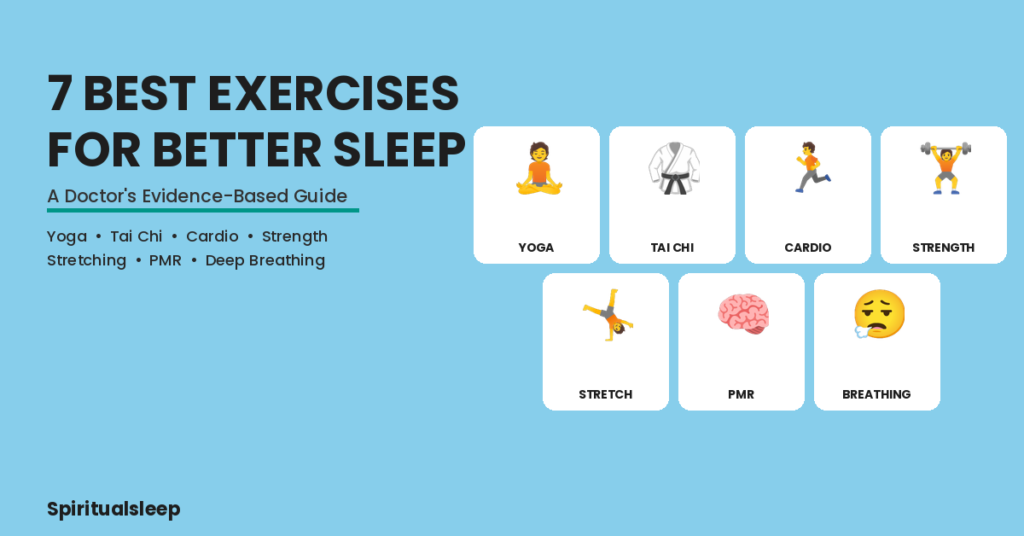
The 7 Best Exercises for Better Sleep
1. Yoga
Yoga combines movement, breathwork, and mindfulness to directly activate the parasympathetic nervous system, which is your body’s rest-and-digest mode. This is what makes it uniquely effective for sleep compared to most other forms of exercise.
Research published in the Journal of Clinical Sleep Medicine found that regular yoga practice significantly improved sleep quality in adults with chronic insomnia.
The best poses for sleep include Child’s Pose for relaxing the lower back, Legs-Up-the-Wall for reducing anxiety, and Corpse Pose for releasing full-body tension. Practice a 15 to 20 minute routine within an hour of bedtime, keeping movements slow and breath-focused.
2. Tai Chi
Tai Chi uses slow, flowing movements combined with deep breathing to calm the mind and body simultaneously. It is particularly effective for older adults and anyone carrying high levels of daily stress.
A review in the Journal of Sleep Research confirmed that Tai Chi significantly reduced insomnia symptoms across multiple clinical trials. Aim for 20 to 30 minutes per session in the evening, starting with basic online tutorials before joining a class.
3. Aerobic Exercise (Cardio)
Moderate-intensity cardio, including brisk walking, jogging, cycling, or swimming, is one of the most studied sleep interventions available. It increases slow-wave deep sleep, which is the most physically restorative stage of the sleep cycle.
A study in Mental Health and Physical Activity found that 150 minutes of moderate aerobic exercise per week improved sleep quality by 65% in adults with chronic sleep complaints. Schedule cardio in the morning or early afternoon and avoid vigorous sessions within two hours of bedtime.
4. Strength Training
Resistance training increases the proportion of slow-wave sleep and helps stabilize blood sugar overnight. This prevents the middle-of-the-night wake-ups caused by glucose fluctuations, which are more common than most people realize.
Two to three sessions per week targeting major muscle groups is enough to see clear sleep benefits. If you prefer evening training, keep the intensity moderate and finish at least 90 minutes before bed.
5. Stretching
Static stretching before bed addresses one of the most common causes of nighttime waking: physical discomfort and muscle tension built up throughout the day.
Ten to fifteen minutes of targeted stretching focusing on the hamstrings, lower back, neck, and shoulders reduces the restlessness that keeps people tossing and turning. Pair each stretch with slow nasal breathing to amplify the relaxation effect.
6. Progressive Muscle Relaxation
Progressive Muscle Relaxation (PMR) is a clinical technique used widely in cognitive behavioral therapy for insomnia. It involves deliberately tensing each muscle group for five seconds and fully releasing it, working upward from feet to face.
PMR trains your nervous system to recognize and release tension. Most people who practice it consistently fall asleep faster and report fewer nighttime awakenings within two to three weeks.
7. Deep Breathing Exercises
Deep breathing activates the vagus nerve, which signals the brain to shift from alert mode into rest mode. It directly lowers heart rate and blood pressure, both of which need to drop before sleep can begin.
The 4-4-6 method works well before sleep. Inhale through your nose for four counts, hold for four counts, then exhale through your mouth for six counts. The extended exhale activates the parasympathetic response more powerfully than the inhale. Repeat for five to ten cycles in bed. Deep breathing is covered in much greater detail in our dedicated guide.
A Doctor’s Personal Experience
In my practice, I had a patient in her mid-40s with a two-year history of insomnia. She had tried melatonin, antihistamine sleep aids, and multiple meditation apps without any lasting results.
After reviewing her daily routine, the issue became clear. She sat at a desk for nine hours a day with almost no physical activity and carried significant work stress home every evening.
I suggested three 30-minute brisk walks per week scheduled before 5pm, combined with a 15-minute bedtime yoga and stretching routine. Within four weeks, she was falling asleep in under 20 minutes and waking up genuinely rested for the first time in years.
How to Build This Into Your Routine
If you also struggle with waking frequently during the night, it is worth reading about how to stop being a light sleeper. You do not need to overhaul your lifestyle overnight. These four principles make the process practical and sustainable.
- Start with one change:Pick the exercise type that feels most accessible and do it consistently for two weeks before adding anything else.
- Protect your timing:Schedule cardio and strength training in the morning or afternoon. Reserve yoga, stretching, PMR, and deep breathing for the evening only.
- Consistency beats intensity:Three moderate workouts per week done consistently for months will improve your sleep far more than occasional intense sessions.
- Combine types strategically:Cardio three times a week plus a nightly 10-minute stretching and breathing routine covers all the major sleep-promoting mechanisms.
Conclusion
The best exercises for better sleep work through distinct but complementary mechanisms. Cardio builds sleep pressure, yoga and Tai Chi calm the nervous system, and stretching with deep breathing prepare your body for rest in the final hour before bed.
You do not need to do all seven. Start with one or two, stay consistent, and track your sleep over three to four weeks. Most people notice a real difference within the first month.
If sleep problems persist despite regular exercise, speak with a healthcare professional to rule out underlying conditions like sleep apnea or clinical anxiety.
Medical Disclaimer:This article is based on thorough research, scientific studies, and my personal experience as a medical doctor interested in sleep health. This content is for informational purposes only and should not be considered medical advice. Each individual’s sleep needs and health conditions are unique. I recommend consulting with a healthcare professional or sleep specialist to address specific concerns.