
How to Stop Having Nightmares Every Night: A Doctor’s Complete Guide
Knowing how to stop having nightmares every night starts with understanding what is driving them. Nightmares are not random. They have identifiable causes and respond well to targeted interventions when those causes are properly addressed.
As an MBBS doctor with a focus on sleep health, I have worked with patients experiencing chronic nightmare disorder and I have seen consistent results from the approaches covered in this guide. The key is applying the right strategy to the right cause rather than trying generic tips that ignore the underlying driver.
Table of Contents
Why Nightmares Happen Every Night
Occasional nightmares are a normal part of sleep. Nightly or near-nightly nightmares indicate something specific is maintaining them. The most common drivers include.
- Stress and anxiety:High baseline cortisol keeps the nervous system in a low-level alert state that carries directly into dream content. The brain processes unresolved threats during REM sleep, and when threat load is high, this produces disturbing dreams consistently.
- Trauma and PTSD:Post-traumatic nightmares are among the most treatment-resistant sleep problems because the brain is replaying fear memories as part of its processing attempt. These require specific clinical approaches.
- Sleep disorders:Sleep apnea causes repeated micro-arousals during REM sleep that increase nightmare frequency. Insomnia fragments sleep architecture in ways that intensify dream vividness. Some people who experience nightmares also report dreams where they cannot move or feel paralyzed.
- Medications:Antidepressants, beta-blockers, and some blood pressure medications can increase REM intensity and nightmare frequency as a side effect.
- Alcohol:Alcohol suppresses REM sleep in the first half of the night and causes REM rebound in the second half, producing unusually vivid and disturbing dreams.
- Poor sleep hygiene:Irregular sleep schedules disrupt circadian rhythm and fragment REM cycles in ways that intensify dream content.
How Nightly Nightmares Affect Your Health
- Sleep avoidance:Many people begin delaying bedtime to avoid nightmares, creating chronic sleep deprivation on top of the nightmare problem.
- Daytime fatigue:Repeated REM disruptions prevent the emotional and physical restoration sleep provides.
- Mental health deterioration:Chronic nightmares are strongly linked to worsening anxiety, depression, and suicidal ideation.
- Cognitive impairment:REM sleep is critical for emotional memory processing and decision-making. Disrupted REM consistently reduces these functions over time.
How to Stop Having Nightmares Every Night
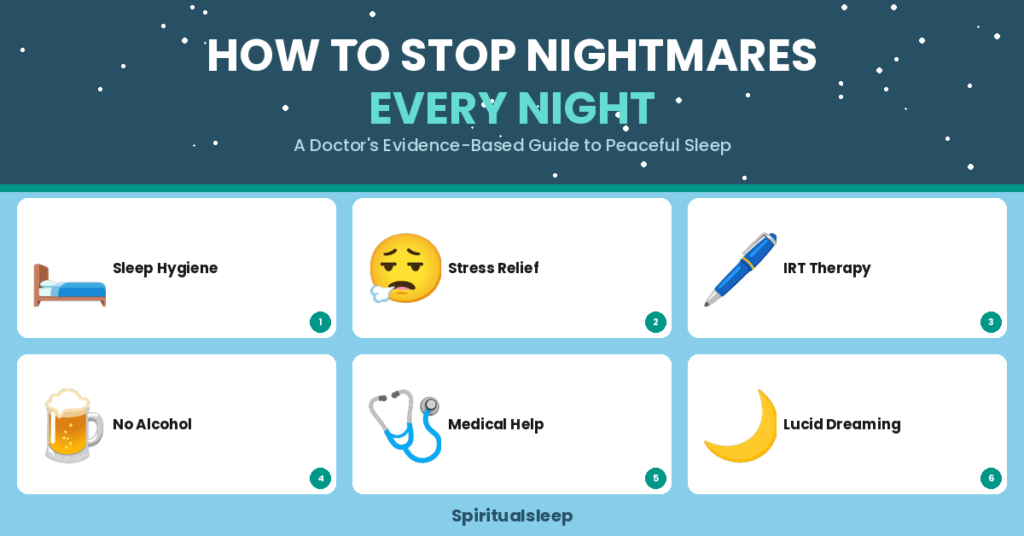
1. Improve Your Sleep Hygiene
A disrupted circadian rhythm and fragmented sleep architecture both worsen nightmare frequency. Stabilizing sleep produces measurable reductions in nightmare intensity within one to two weeks.
- Fix your sleep schedule:Go to bed and wake at the same time every day without exception. Consistency rebuilds circadian rhythm faster than any supplement or medication.
- Build a calming pre-sleep routine:30 minutes of quiet, screen-free activity before bed signals the nervous system that the threat-processing phase of the day is over.
- Optimize your bedroom:Cool, dark, and quiet conditions reduce the light-sleep awakenings that make nightmare content more easily recalled and more distressing.
- Limit caffeine and nicotine after midday:Both stimulants increase REM intensity by elevating cortisol and keeping the nervous system more active during sleep.
2. Manage Stress and Anxiety Before Bed
Since elevated cortisol is the most common nightmare driver, reducing it before sleep directly reduces nightmare frequency. These techniques lower cortisol measurably within minutes.
- 4-6 breathing:Inhale for four counts, exhale for six counts. The extended exhale activates the vagus nerve and shifts the nervous system from sympathetic to parasympathetic mode.
- Progressive Muscle Relaxation:Tense each muscle group for five seconds and fully release from feet to face. This discharges the physical tension that keeps cortisol elevated at bedtime.
- Pre-bed journaling:Write down active worries and tomorrow’s tasks before sleep. This offloads the mental loop that keeps threat-processing active during REM.
- Mindfulness meditation:Even 10 minutes of focused breathing before bed measurably reduces amygdala reactivity, the brain region that generates fear responses in dreams.
Deep breathing before bed is one of the fastest ways to lower the cortisol that drives nightmare content.
3. Use Image Rehearsal Therapy
Image Rehearsal Therapy (IRT) is the most evidence-based treatment for chronic nightmares outside of PTSD-specific clinical approaches. Multiple randomized controlled trials have confirmed its effectiveness for both trauma-related and non-trauma nightmare disorder.
The method works by rewriting the nightmare narrative while awake, then rehearsing the new version repeatedly until the brain replaces the original fear association with the rewritten version.
How to do it:Write a detailed description of your recurring nightmare. Then rewrite the ending or key scenes to produce a neutral or positive outcome. Spend 10 to 15 minutes each day vividly imagining the rewritten version. After two to four weeks of daily rehearsal, most patients notice the original nightmare either transforms or stops occurring.
4. Eliminate Alcohol Before Bed
Alcohol is one of the most potent nightmare triggers available and one of the easiest to remove. The REM rebound effect it causes in the second half of the night produces some of the most vivid and disturbing dreams most people will ever experience. Stopping alcohol within three hours of bed reduces nightmare frequency significantly for most people within the first week.
5. Address Underlying Medical Conditions
- Sleep apnea:CPAP therapy often resolves nightmare frequency completely in apnea patients.
- PTSD:Trauma-related nightmares require specific clinical treatment. EMDR and trauma-focused CBT are both strongly supported by evidence. Prazosin has also demonstrated clear effectiveness for PTSD-related nightmare suppression.
- Medication review:If nightmares started or worsened when a new medication was introduced, discuss this with your doctor. Timing adjustments or medication alternatives often resolve the problem.
6. Use Lucid Dreaming Techniques
For people whose nightmares follow a consistent pattern, learning to become aware within the dream gives you direct control over the experience. Reality checks practiced consistently during waking hours, combined with the MILD technique at bedtime, produce lucid dreams in most practitioners within two to six weeks.
Once achieved, even partial control over a nightmare significantly reduces its distress impact. Learning how to start lucid dreaming gives you direct control over nightmare content from within the dream.
7. Seek Professional Therapy if Needed
- CBT-I:Addresses the negative thought patterns around sleep that develop alongside nightmare disorder and rebuilds healthy sleep architecture.
- Trauma-focused therapy:For PTSD-related nightmares, specialist therapy addresses the memory consolidation problem driving the dreams.
- Medication:Prazosin for PTSD nightmares and other options should be discussed with a doctor if behavioral approaches alone are insufficient.
A Doctor’s Personal Experience
In my practice, I treated a young woman recovering from PTSD following a road accident. She was experiencing nightly flashback nightmares that left her emotionally exhausted each morning and increasingly reluctant to go to bed at night.
We started with Image Rehearsal Therapy alongside a consistent bedtime and a pre-sleep mindfulness routine. Within four weeks her nightmare frequency reduced from nightly to two to three times per week. Within eight weeks she was sleeping through most nights without nightmare interruption for the first time since the accident.
I have also used deep breathing and journaling myself during high-stress clinic periods when unsettling dreams began interfering with sleep. The combination of writing down active worries before bed and practicing 4-6 breathing consistently produces noticeably calmer sleep within three to four days.
Frequently Asked Questions
Are nightly nightmares a sign of a mental health condition?
Not always, but they are a significant risk factor. Chronic nightmares are strongly associated with anxiety, depression, and PTSD. If they persist despite good sleep hygiene and stress management, a professional evaluation is worth pursuing.
How long does Image Rehearsal Therapy take to work?
Most people notice meaningful changes within two to four weeks of daily rehearsal practice. Clinical trials report significant nightmare reduction within four to six weeks in the majority of participants.
Can children use these techniques?
Yes. Simplified versions of IRT, consistent sleep schedules, and relaxation techniques before bed are all appropriate for children. A pediatric psychologist or sleep specialist should guide treatment for children with frequent or severe nightmares.
When should I see a doctor about nightmares?
If nightmares occur more than once per week, cause significant sleep avoidance, or are linked to a traumatic event, a medical or psychological evaluation is the right step rather than continued self-management alone.
Conclusion
Learning how to stop having nightmares every night requires identifying what is driving them and applying the matching intervention. Sleep hygiene, stress management, and alcohol elimination address the most common non-clinical causes. IRT is the gold standard behavioral treatment. Medical conditions require medical treatment.
Start with the two changes most relevant to your situation tonight. If you drink alcohol in the evening, stop it. If stress is the driver, add journaling and breathing before bed. If a specific recurring nightmare is the issue, begin Image Rehearsal Therapy.
Chronic nightmares are treatable. Consistent application of the right approach produces real and lasting results.
Medical Disclaimer:This article is based on thorough research, scientific studies, and my personal experience as a medical doctor interested in sleep health. This content is for informational purposes only and should not be considered medical advice. Each individual’s sleep needs and health conditions are unique. I recommend consulting with a healthcare professional or sleep specialist to address specific concerns.