Meditation vs Sleep: Can Meditation Replace Sleep?
The meditation vs sleep question comes up most often at the worst possible time: 11 p.m., still wired, knowing the alarm is set for six. You have heard that meditation gives deep rest. So a tempting shortcut appears. Could twenty quiet minutes stand in for a couple of hours under the covers?
It is a fair question, and the internet is full of confident answers that contradict each other. Some sites promise meditation can shrink your sleep need. Others say the two have nothing in common. The truth sits in between, and it matters for your health, so let me walk you through it as clearly as I can.
Short answer: No, meditation cannot replace sleep. They do different jobs in the body. Sleep handles deep physical repair, memory, and brain cleanup that nothing else can do. Meditation calms your nervous system and lowers stress, which helps you sleep better. Use them together, not one instead of the other.
Table of Contents
The Problem: Most of Us Are Running on Empty
Short sleep is not a rare problem. Roughly one in three adults in the US and UK regularly falls short of the sleep they need. Busy schedules, late screens, and stress have made “tired” feel normal.
The cost is real, and it adds up quietly:
Cloudy thinking: Sleep loss drags down focus, memory, and judgment, often before you notice it happening.
Shakier moods: Too little sleep feeds anxiety, irritability, and low mood, which then make the next night harder.
Physical strain: Ongoing short sleep is linked to weight gain, high blood pressure, blood sugar problems, and a weaker immune system.
When you feel that drained, “just meditate instead” starts to sound like a solution. So people reach for it, hoping to buy back a few hours.
The Confusion: Can You Trade Sleep for Meditation?
This is where the mixed messages pile up. People ask the same handful of questions, and they deserve straight answers rather than hype.
The common ones I hear: “Can I meditate instead of sleeping?” “Does twenty minutes of meditation equal a few hours of sleep?” “Which one is better for my mind?” To answer any of them, you have to look at what each state actually does inside your brain and body. They feel similar from the outside. They are not the same thing.
What Actually Happens When You Sleep
Sleep is not your brain switching off. It is your brain and body running a nightly maintenance program, moving through cycles roughly every ninety minutes. Those cycles split into two very different kinds of work.
The Repair Shift (Deep Sleep)
During the deep stages of non-REM sleep, your body does its heavy lifting. It repairs tissue, releases growth hormone, and strengthens the immune system.
Your brain gets a literal wash, too. In deep sleep the brain clears out metabolic waste, including proteins linked to long-term decline. This clean-out only reaches full swing when you are genuinely asleep, which is a big part of why no waking practice can stand in for it.
The Processing Shift (REM Sleep)
REM sleep is where dreaming lives. Here your brain sorts through the day, files memories for long-term storage, and works through emotion.
Skip enough REM and it shows up as poor recall, flat learning, and a shorter emotional fuse. Meditation is wonderful for many things, but it does not run this filing system for you.
What Actually Happens When You Meditate
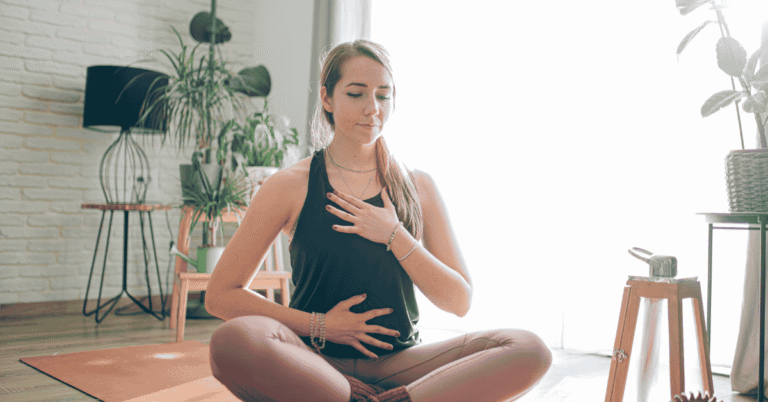
Meditation is a waking practice. You stay conscious and aware, but you guide your attention until the body settles and the mental noise drops.
In that state your brain tends to produce slower, calmer brainwaves, your heart rate eases, and your stress response steps down. There are many ways in, and no single one is correct:
Mindfulness meditation: You rest your attention on the breath or the present moment, and gently return whenever the mind wanders.
Body scan and relaxation: You move attention slowly through the body, releasing tension as you go.
Guided visualization: You follow a voice or a calming mental image to reach a relaxed state. If you are not sure where to begin, our guide on which meditation is best for sleep walks through the options and who each one suits.
The key point: meditation quiets and resets the mind while you are awake. Sleep shuts the whole system down for repair. Both are rest. They are not the same rest.
Meditation vs Sleep: The Key Differences
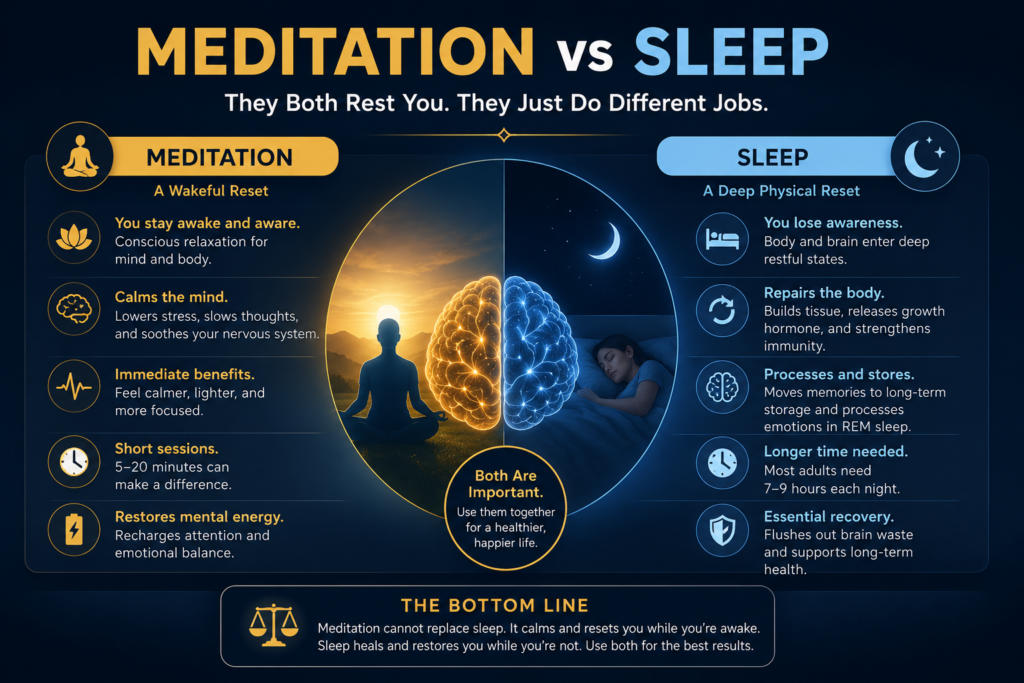
Put side by side, the contrast is easy to see:
Awareness: In meditation you stay awake and aware. In sleep you lose conscious awareness.
Main job: Meditation lowers stress and calms the mind. Sleep restores the body and consolidates memory.
Time needed: A useful meditation can last five to twenty minutes. Adults need seven to nine hours of sleep.
Physical recovery: Meditation offers little deep physical repair. Sleep delivers most of it.
When you feel it: Meditation often brings calm right away. Sleep pays off across the whole next day and beyond.
Can Meditation Replace Sleep?
Here is the honest, science-backed answer: no. Meditation cannot replace sleep, because it cannot reach the states where the most important recovery happens.
Deep, slow-wave sleep and REM are where your body repairs itself, where memories move into long-term storage, and where your brain flushes out waste. Meditation, however deep it feels, keeps you in a waking state that does not deliver those specific processes. You can feel calm and refreshed after meditating and still be carrying a real sleep debt underneath. Skipping sleep to meditate does not clear that debt. It just hides it for a while, and the bill comes due in worse focus, mood, and health.
Think of it this way. Sleep is the overnight service your body cannot skip. Meditation is a mid-drive reset that helps the engine run smoother. One does not do the other’s job.
Does Twenty Minutes of Meditation Equal Hours of Sleep?
You may have seen claims like “ten minutes of meditation replaces forty-four minutes of sleep.” These come from small studies, and they get stretched far beyond what the research actually shows.
There is a real finding underneath the hype. One study on meditation and alertness found that a session could sharply improve reaction time, more than a short nap did, and suggested that very experienced meditators might need slightly less sleep over time. That is interesting, but it is not the same as replacing sleep. Faster reaction time for an hour is not deep tissue repair or memory consolidation overnight. For nearly everyone, the practical takeaway is simple: meditation can help you feel sharper in the moment, but it is not a swap for the hours your body still needs.
How Meditation Makes Your Sleep Better
This is where meditation truly earns its place. It is not a replacement for sleep. It is one of the best tools you have for improving the sleep you do get, and the research backs this up.
A large meta-analysis of 61 controlled trials found that mindfulness practices significantly improved sleep quality across thousands of participants. Other systematic reviews of randomized trials reach the same conclusion, and a 2023 review in older adults with sleep problems found benefits that held up over both the short and long term. Here is how it works:
It lowers stress hormones: Meditation helps bring down cortisol, the stress hormone that keeps you tense and wired at night. Lower cortisol makes it easier for your body to shift toward sleep and let melatonin rise. Our post on how to increase melatonin naturally covers that hormone side in more detail.
It quiets a racing mind: The biggest barrier to sleep for many people is a head that will not stop. Meditation trains you to step back from spinning thoughts, and pairing it with a short wind-down journaling routine helps even more.
It calms the body directly: Slow, focused breathing switches on the parasympathetic nervous system, the “rest and digest” side. The simple vagus nerve exercises for sleep in our guide use this same effect to help you unwind before bed.
It supports deeper sleep: By easing you into sleep more relaxed, regular practice is linked with better, more restorative rest, not just faster sleep onset.
A Doctor’s Personal Experience
I learned the difference between these two the hard way, during long hospital stretches early in my career. On weeks packed with night shifts and emergencies, real sleep was not always on offer, and I looked for anything that would keep me steady.
Meditation became that anchor. After a brutal shift, I would take fifteen minutes to sit and breathe before heading home, which pulled me out of high alert and let me actually rest afterward. On nights when stress kept my mind looping, a short guided session helped me fall asleep faster than lying there fighting it. I want to be honest about what it did and did not do. It never replaced the sleep I was missing, and on too little sleep I still felt it the next day. What it did was protect the quality of whatever sleep I could get. I now recommend the same to patients wrestling with stress or insomnia: treat meditation as the thing that improves your sleep, not the thing that lets you skip it.
How to Use Both for Better Rest
The goal is not to choose. It is to let each do its job. A little planning makes both easier.
Protect your sleep first: Keep a steady sleep and wake time, cut caffeine after early afternoon, and build a calm pre-bed routine. Our full guide on how to sleep better and longer covers the essentials, and our free Sleep Cycle Calculator helps you pick a bedtime built around complete sleep cycles.
Add meditation as a daily habit: Start with five to ten minutes. Consistency matters more than length, so the same short session every day beats an occasional long one.
Use it at the right moments: A brief session in the evening can settle a busy mind for sleep. A short one midday can lift a slump without wrecking your night the way a long late nap might.
Conclusion
The meditation vs sleep debate has a clear winner only if you frame it wrong. Neither one wins, because they were never competing. Sleep does the deep repair, memory work, and brain cleanup your body cannot get any other way. Meditation calms your stress and your mind, which makes that sleep come easier and feel deeper.
So do not trade one for the other. Guard your seven to nine hours as non-negotiable, and let a short daily meditation practice support them. Used together, they build a kind of rest that neither can create alone. Start tonight with a steady bedtime and ten quiet minutes, and give your body both forms of recovery it is asking for.
Medical disclaimer: This article is for general information only and is not a substitute for professional medical advice, diagnosis, or treatment. If you have ongoing sleep problems, insomnia, or a health condition, speak with your doctor or a qualified sleep specialist before making changes to your routine.
References
- Yang J, Du Y, Shen H, et al. Mindfulness-Based Movement Intervention to Improve Sleep Quality: A Meta-Analysis and Moderator Analysis of Randomized Clinical Trials (2022). International Journal of Environmental Research and Public Health. https://www.ncbi.nlm.nih.gov/pmc/articles/PMC9408303/
- Rusch HL, Rosario M, Levison LM, et al. The effect of mindfulness meditation on sleep quality: a systematic review and meta-analysis of randomized controlled trials (2019). Annals of the New York Academy of Sciences. https://pmc.ncbi.nlm.nih.gov/articles/PMC6557693/
- Effects of mindfulness-based cognitive therapy on older adults with sleep disorders: a systematic review and meta-analysis (2023). Frontiers in Public Health. https://www.ncbi.nlm.nih.gov/pmc/articles/PMC10765593/
- Meditation for subjective cognitive decline, mild cognitive impairment and Alzheimer’s disease: a systematic review and meta-analysis of randomized controlled trials (2024). Frontiers in Aging Neuroscience. https://www.ncbi.nlm.nih.gov/pmc/articles/PMC12162321/
- Kaul P, Passafiume J, Sargent CR, O’Hara BF. Meditation acutely improves psychomotor vigilance, and may decrease sleep need (2010). Behavioral and Brain Functions. https://pmc.ncbi.nlm.nih.gov/articles/PMC2919439/