Schizophrenia and Sleep Problems: Why They Happen and How to Sleep Better
Schizophrenia and sleep problems show up together so often that most doctors treat poor sleep as part of the condition, not a side issue. If you live with schizophrenia, or you care for someone who does, you have probably watched nights turn into a fight. Falling asleep takes hours. Sleep breaks apart at 3 a.m. Day and night quietly swap places.
This post explains why that happens, how broken sleep feeds back into symptoms, and what actually helps you rest. The habits here support your sleep. They do not replace the care of your mental health team, and that line matters from the first paragraph to the last.
This is also a condition I have studied beyond everyday care. I was one of the co-authors on a published study on schizophrenia treatment, so the link between schizophrenia and sleep is one I have followed closely for years.
Short answer: Sleep problems affect most people with schizophrenia, often appear before any other symptom, and can make hallucinations, paranoia, and low mood worse. Better sleep will not cure schizophrenia, but a steady routine, morning light, and the right medical support can improve rest and help you feel steadier.
Table of Contents
Why Sleep Problems Are So Common in Schizophrenia
Sleep trouble is not a rare add-on with schizophrenia. It is closer to the rule. Research suggests that up to 80% of people with schizophrenia deal with disturbed sleep at some point.
These problems often start early. A 2025 umbrella review of dozens of studies found that disturbed sleep is an early hallmark of schizophrenia, frequently showing up before a diagnosis is ever made. For many people, sleep is the first thing to slip and the last thing to settle.
There are real reasons for this. Schizophrenia involves changes in brain chemistry and in the body clock that controls when you feel sleepy and when you feel awake. Some medications shift sleep too. Stress, irregular days, and time spent indoors with little daylight then pile on top.
What Sleep Problems Look Like in Schizophrenia
Sleep trouble does not wear one face here. It tends to fall into a few patterns, and many people deal with more than one at the same time.
Insomnia: Trouble falling asleep, staying asleep, or waking far too early. This is the most common complaint, and it often gets worse in the days before a flare-up.
A reversed or scattered body clock: Instead of one solid night, sleep lands at odd hours. Some people are wide awake until dawn and asleep through the afternoon. A 2024 review in PNAS describes how closely the sleep and circadian systems are tied to mental health, each one able to throw the other off.
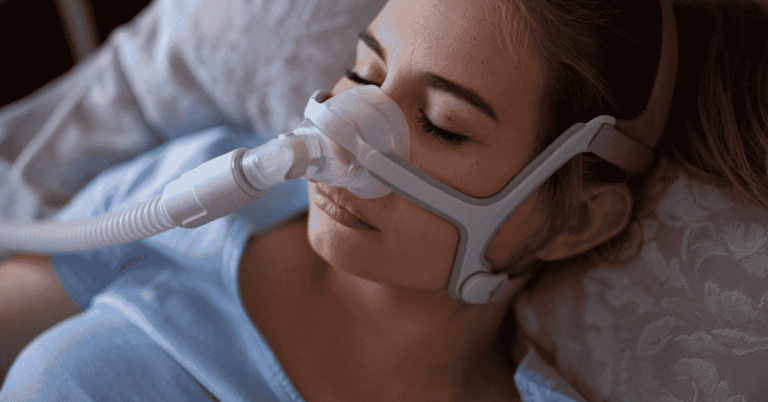
Sleep apnea: Breathing stops and restarts through the night, breaking sleep into fragments. It is more common in schizophrenia, partly because some antipsychotics drive weight gain, and it often goes undiagnosed.
Restless legs and limb movements: An urge to move the legs at rest, or repeated kicking during sleep, that pulls you out of deep rest without you fully waking.
How Poor Sleep Makes Symptoms Worse
Here is the part that turns a nuisance into a real problem. Sleep and symptoms feed each other.
Poor sleep does not just leave you tired. It can sharpen the very symptoms that are hardest to live with. A 2024 meta-analysis in Schizophrenia Research linked poor sleep quality to worse psychiatric symptoms and lower quality of life, and noted that swings in sleep can act as an early warning sign of a coming relapse.
The knock-on effects stack up fast:
Stronger symptoms: Short or broken sleep can intensify hallucinations and paranoid thoughts, making them louder and harder to dismiss.
Foggy thinking: Attention, memory, and decision-making all dip after a bad night, on top of the cognitive challenges schizophrenia already brings.
Mood swings: Sleep loss feeds anxiety, irritability, and low mood, which then make it even harder to wind down.
Daytime crash: Nights spent awake lead to days spent dozing, which scatters the body clock further. It becomes a loop, and the loop tightens on its own.
Does Treating Sleep Help Schizophrenia?
This is the question worth sitting with, so here is the direct answer.
Treating sleep does not cure schizophrenia, and no honest source claims it does. What the evidence does show is that better sleep can ease the load. Studies reviewed in that 2025 umbrella review point to a two-way street: disrupted sleep can drive symptoms, and targeting sleep can soften them.
That is genuinely good news, because sleep is one of the few pieces of this puzzle you can act on directly. It also means sleep deserves a real place in the treatment plan, alongside, never instead of, the medication and support your mental health team provides.
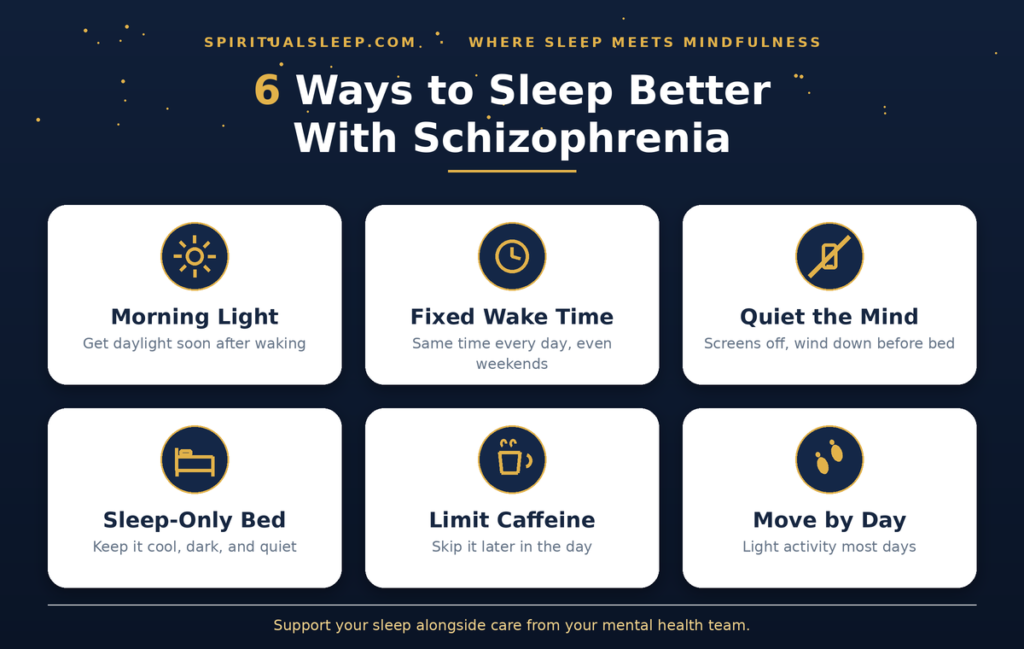
How to Sleep Better With Schizophrenia
Now the practical part. None of this replaces medical care, and you should run any big change past your doctor first. But these steps are the foundation, and small wins here add up. If you want the full version of these habits, our guide on how to sleep more than 5 hours breaks each one down in detail.
Anchor Your Body Clock With Morning Light
Light is the strongest signal your body clock has. Get outside, or sit by a bright window, within an hour of waking, even on grey days.
Daylight in the morning helps your brain release sleepiness at the right time that night. Our walk-through on how to increase melatonin naturally covers how light and darkness shape the sleep hormone, which is the exact system that runs off the rails in schizophrenia.
Keep One Fixed Wake-Up Time
You cannot force sleep, but you can set your wake time. Pick one, and hold it seven days a week, even after a rough night.
A steady morning slowly pulls the rest of your sleep into place. If you are not sure what bedtime to aim for, our free Sleep Cycle Calculator works backward from your wake-up time to suggest target bedtimes built around full sleep cycles.
Build a Wind-Down Routine That Quiets the Mind
A racing mind is one of the biggest blocks to sleep here. Give your brain 30 to 60 minutes to slow down before bed, with the screens off and the lights low.
Two things help when thoughts will not stop. Writing them down works, and our post on how journaling can help you sleep shows simple ways to empty a busy head onto paper. So does calming the body directly, and the slow-breathing methods in our vagus nerve exercises for sleep guide help switch off the wired, on-edge feeling that keeps you staring at the ceiling.
Make the Bedroom Work for Sleep
Your room should signal rest the moment you walk in. Aim for cool, dark, and quiet, and keep the bed for sleep, not for scrolling or worrying.
Small fixes go a long way: blackout curtains, an eye mask, earplugs, or white noise. If light noises or movement jolt you awake, our tips on how to stop being a light sleeper are worth a read.
Be Careful With Caffeine, Nicotine, and Late Naps
Caffeine and nicotine are stimulants, and they linger for hours. Cut caffeine after early afternoon, and try not to lean on cigarettes late at night to settle down, since they do the opposite under the surface.
Long daytime naps backfire too. They drain the sleep pressure you need for the night, so the body clock drifts even further.
Move Your Body During the Day
Daytime activity earns you deeper sleep at night. You do not need a gym. A walk, some stretching, or light movement most days is plenty.
Exercise also lifts mood and burns off restless energy, which makes the wind-down easier. Just keep hard workouts away from the last hour or two before bed.
Review Medication Timing With Your Doctor
Some antipsychotics cause drowsiness, and others can make sleep harder. Timing matters as much as the medicine itself.
If a medication leaves you groggy in the morning or wired at night, do not adjust it yourself. Bring it to your prescriber, who can shift the dose or the timing safely.
Ask About CBT for Insomnia
Cognitive behavioral therapy for insomnia, or CBT-I, is a structured, drug-free approach that retrains the habits and thoughts that block sleep. It is well studied and increasingly offered to people with serious mental illness.
Ask your mental health team whether it is available to you. It targets the sleep problem itself, rather than just masking it.
When to Seek Professional Help
Some things need more than a better routine, and recognising them early protects you.
Reach out to your mental health team if sleep collapses suddenly, if you go long stretches with almost no sleep, or if symptoms like voices or paranoia start climbing. A sharp change in sleep can be an early sign of a flare, and catching it early often means a gentler path through it. If you or someone you support feels unsafe or in crisis, contact a doctor, a local crisis line, or emergency services right away. You do not have to wait it out alone.
A Doctor’s Personal Experience
As a doctor, I have learned to ask about sleep early, because it often tells me more than the person realises. I remember a young man brought in by his family, worn down after weeks of nights that started later and later until day and night had switched completely. His family thought he was simply staying up. What I saw was a body clock that had lost its anchor.
I did not try to fix this alone, and I want to be clear about that. I made sure he stayed connected to his psychiatric care, and alongside it we kept things simple: one fixed wake-up time, morning light by the window, and a short wind-down with the phone out of reach. None of it was dramatic. Over a few weeks his nights pulled back toward normal, and his family told me he seemed more like himself. That is the pattern I keep seeing. Sleep is rarely the whole answer, but it is almost always part of it.
Conclusion
Schizophrenia and sleep problems travel together, and they pull on each other. Disturbed sleep can show up before anything else, and it can make hard symptoms harder, which is exactly why sleep deserves real attention rather than a shrug.
The encouraging part is how much of this you can influence. Morning light, one steady wake-up time, a calm wind-down, a bedroom built for rest, and honest conversations with your doctor about medication and CBT-I all stack up. None of these replace your treatment, and none are a cure. But better sleep can steady the ground under your feet, and on this condition, steadier ground counts for a lot. Start with one change tonight, and build from there.
Medical disclaimer: This article is for general information only and is not a substitute for professional medical advice, diagnosis, or treatment. Schizophrenia is a serious condition that requires care from a qualified health professional. Always speak with your doctor or mental health team before making changes to your treatment, medication, or sleep routine.
References
- Sleep disturbances are associated with psychosis in schizophrenia spectrum disorders: an umbrella review (2025). ScienceDirect. https://www.sciencedirect.com/science/article/abs/pii/S138994572500365X
- The sleep–circadian interface: a window into mental disorders (2024). PNAS. https://www.pnas.org/doi/10.1073/pnas.2214756121
- Poor sleep quality in schizophrenia patients: a systematic review and meta-analysis (2024). Schizophrenia Research. https://www.sciencedirect.com/science/article/abs/pii/S0920996424000112
- Meyer N, Faulkner SM, McCutcheon RA, et al. Sleep and circadian rhythm disturbance in remitted schizophrenia and bipolar disorder: a systematic review and meta-analysis (2020). Schizophrenia Bulletin. https://academic.oup.com/schizophreniabulletin/article/46/5/1126/5802515
- Sleep disturbances in major psychiatric disorders: prevalence, mechanisms and treatment, a narrative review (2025). International Journal of Innovative Technologies in Social Science. https://rspublisher.org/index.php/ijitss/article/view/4307