
Sleep and Study: Should You Sleep or Study Before an Exam?
The sleep and study battle almost always comes down to one moment: it is late, the exam is close, and you have to choose between one more hour of notes or one more hour in bed. It feels obvious that more studying wins. Your brain says otherwise.
I have watched students pour hours into late-night cramming and still walk out of exams frustrated, sure they knew the material the night before. The problem was rarely effort. It was sleep, or the lack of it. Let me show you what actually happens in your brain, so you can stop trading away the very thing that locks learning in.
Short answer: For most students, sleep beats cramming. Sleep is when your brain moves what you studied into long-term memory. Pulling an all-nighter can leave you as impaired as being over the drink-driving limit, so a solid night’s sleep usually helps your exam score more than one more hour of tired revision.
Table of Contents
The Problem: Why Sleep and Study Feel Like a Trade-Off
For students, sleep is usually the first thing sacrificed and the last thing valued. When deadlines pile up, bedtime becomes the flexible budget line you raid for more hours.
A few habits make it worse:
Procrastination: Work pushed to the last minute forces late-night sessions that eat into sleep.
Screens everywhere: Phones and laptops before bed suppress melatonin, so even when you stop studying, sleep does not come easily.
Exam anxiety: A mind spinning with worry about tomorrow keeps you awake long after you close the books.
The “sleep is optional” myth: Many students treat rest as wasted time, not realizing that skipping it quietly cancels out the studying they just did.
That last point is the heart of the problem. To see why, you have to understand what your brain does with your studying while you sleep.
What Sleep Actually Does for Your Studying
Sleep is not downtime for a student brain. It is the shift where the day’s learning gets processed, sorted, and stored. Skip it and you are not saving time, you are throwing away work you already did.
It Moves Learning Into Long-Term Memory
When you study something new, your brain forms fresh connections to hold it. Those connections start out fragile. During sleep, your brain strengthens the useful ones and clears away the noise, moving information from short-term into long-term memory.
This is not a theory. In one 2025 study on university students, people who slept after learning passages of text recalled noticeably more detail than those who stayed awake. Sleep did the filing that studying alone could not.
It Recharges Focus and Judgment
Your prefrontal cortex runs attention, planning, and decision-making. It is also one of the first parts of the brain to fade when you are short on sleep.
A 2025 study of students in London and Tokyo linked better sleep quality to stronger cognitive function. Tired studying is slow studying, where you reread the same paragraph three times and still miss it.
It Steadies Your Mood for Exams
Sleep loss shortens your emotional fuse. It feeds the anxiety and irritability that make studying harder and exam rooms more stressful.
A calmer, rested mind reads questions more clearly and panics less when a hard one appears. That steadiness is worth as much as the facts you memorized.
The All-Nighter Myth: Does Cramming Work?
Here is the honest answer: no, cramming does not work the way you hope. It feels productive at 2 a.m., but the science is not on its side.
When you cram, you load information into short-term memory, which is like a sticky note. It holds a little, briefly, then lets go. Without sleep to consolidate what you learned, most of it slips away by the time you sit the exam. There is a physical catch, too. When you cut your night short, you lose the later stretches of REM sleep, which is exactly the stage that helps cement new learning.
Worse, staying awake all night can impair your thinking about as much as being over the legal drink-driving limit, which is a rough state to bring into a test. Cramming also spikes stress, and stress makes recall harder, which is why people blank on facts they read hours earlier. Studying in small chunks across several days beats one long night every time.
Is It Better to Sleep or Study Before an Exam?
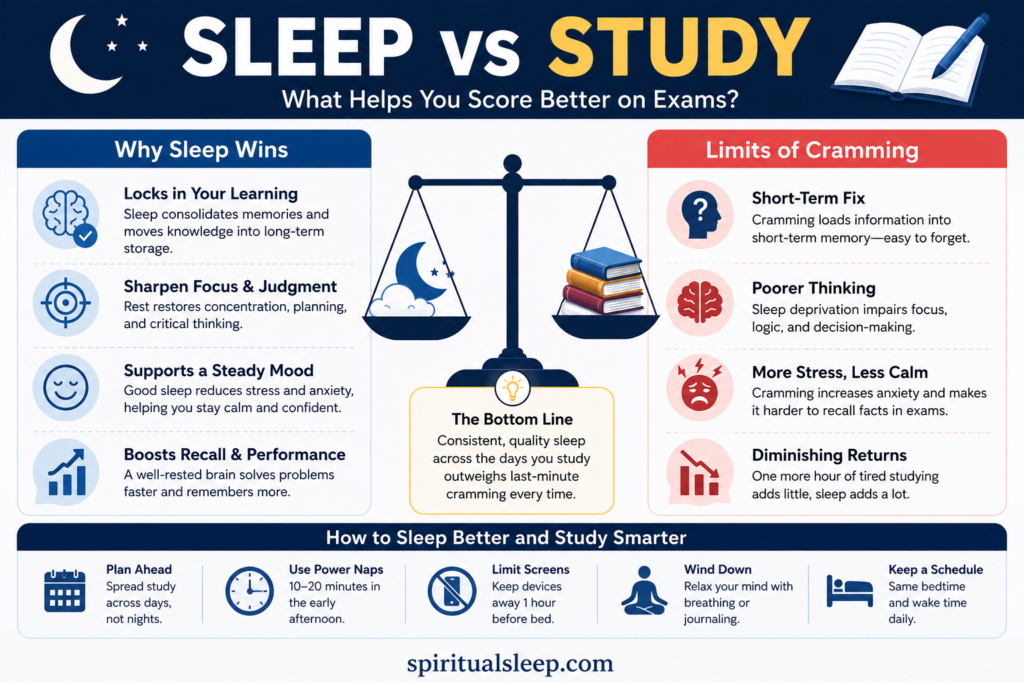
If you are choosing between sleep and study the night before, choose sleep. A rested brain recalls and reasons far better than a depleted one, and one more tired hour rarely adds much.
There is an important twist, though, and a large study of college students makes it clear. Researchers found that sleep quality, duration, and consistency all tracked with better grades, but the sleep students got the single night before a test did not predict their scores. What mattered was the sleep across the days while they were actually learning the material. In other words, you cannot bank poor sleep all week and rescue it with one good night. The real answer is not “sleep or study tonight.” It is to protect your sleep across the whole study period so the learning sticks in the first place.
How Much Sleep Do Students Need?
Sleep guidelines are clear about the targets, even if student life makes them hard to hit:
Young adults (18 to 25): Aim for 7 to 9 hours a night.
Teenagers (14 to 17): Aim for 8 to 10 hours a night.
These are not luxuries. They are the amount of sleep your brain needs to consolidate what you study and show up sharp the next day.
How to Sleep Better and Study Smarter
You do not have to choose between good grades and good sleep. With a little structure, they support each other. Here is how to set both up to win.
Study in Daytime Chunks, Not Midnight Marathons
Your brain learns best in focused bursts, not exhausted late-night slogs. Try the Pomodoro method, around 25 minutes of focused work followed by a 5-minute break.
Spread study across days rather than one panic session, and use active recall, testing yourself, instead of passively rereading. This moves material into long-term memory far more efficiently, and it frees your nights for sleep.
Use Short Naps as a Tool
A brief nap can restore focus and help lock in what you just studied. Keep it to 10 to 20 minutes so you wake up sharp rather than groggy.
Time it for the early afternoon, not late in the day. Our guide on how long a good nap should be breaks down which nap length fits which goal.
Cut Screens and Caffeine Before Bed
Blue light from phones and laptops holds back melatonin, the hormone that makes you sleepy. Put screens away at least an hour before bed, and keep caffeine to the morning, since it can linger in your system for hours.
Our post on how to increase melatonin naturally covers simple ways to protect the hormone your sleep depends on.
Calm Exam Nerves Before Bed
A worried mind is one of the biggest reasons students lie awake. Slow breathing helps, and the simple vagus nerve exercises for sleep in our guide switch on the body’s calming response.
Getting worries out of your head helps too. A short wind-down journaling routine, writing tomorrow’s tasks and any anxious thoughts on paper, tells your brain it can stop rehearsing them.
Keep a Steady Sleep Schedule
A consistent bedtime and wake time is one of the strongest predictors of both good sleep and good grades. A 2025 study using sleep trackers found that steadier sleep patterns went hand in hand with higher academic performance.
Hold the same schedule even on weekends, and let our full guide on how to sleep better and longer and the free Sleep Cycle Calculator help you land on a bedtime built around complete sleep cycles.
Common Sleep and Study Mistakes to Avoid
Even students who mean well fall into the same traps. A few are worth naming, because fixing them is often easier than piling on more study hours.
Treating the all-nighter as a strategy: It should be a rare emergency, not a plan. If you truly must do one, do it several nights before the exam, never the night before.
Rereading instead of recalling: Passively rereading notes feels productive but fades fast. Closing the book and testing yourself is what builds memory that lasts.
Studying in bed: Your brain should link the bed with sleep, not with stress and revision. Work at a desk and keep the bed for rest, so falling asleep stays easy.
Leaning on late caffeine: That afternoon or evening coffee to push through often steals the very sleep that would have locked in your learning.
Chasing weekend catch-up: Sleeping in on Saturday helps a little, but it does not undo a week of short nights. Steady sleep beats extreme swings.
A Doctor’s Personal Experience
I have sat across from many students during exam season, and one visit stays with me. A college sophomore came in worn out and discouraged, convinced she was studying harder than everyone around her yet falling behind.
When we walked through her routine, the pattern was obvious. She was studying until 3 a.m. on coffee, sleeping four or five hours, and cramming the same notes over and over. I asked her to change three things, not her effort. She moved her study into daytime blocks, stopped caffeine after early afternoon, and tested herself on the material instead of rereading it late at night. She kept a steady bedtime and let her brain do its overnight filing. A few weeks later she told me she could actually focus again, and her grades followed. Her studying finally worked, because she stopped trading away the sleep that made it stick.
Conclusion
The sleep and study question has a clearer answer than most students expect. Sleep is not the reward you earn after studying. It is part of studying, the stage where everything you worked on gets saved. Cramming feels productive, but it fills a memory that empties fast, while sleep is what makes learning last.
So do not treat rest as the hour you can always borrow against. Protect your sleep across the whole run-up to an exam, study in focused daytime blocks, and use short naps and a calm bedtime routine to support both. Aim for your 7 to 9 hours, and let your brain finish the job you started at your desk. Start tonight, and give your studying somewhere to land.
Medical disclaimer: This article is for general information only and is not a substitute for professional medical advice, diagnosis, or treatment. If you have ongoing sleep problems, exam-related anxiety, or a health condition affecting your sleep, speak with your doctor or a qualified health professional.
References
- Okano K, Kaczmarzyk JR, Dave N, Gabrieli JDE, Grossman JC. Sleep quality, duration, and consistency are associated with better academic performance in college students (2019). npj Science of Learning. https://www.nature.com/articles/s41539-019-0055-z
- Better sleep is associated with higher academic performance: an actigraphy-based analysis of sleep consistency and grades in college students (2025). Scientific Reports. https://www.nature.com/articles/s41598-025-33775-0
- Investigating the impact of sleep quality on cognitive functions among students in Tokyo, Japan, and London, UK (2025). Frontiers in Sleep. https://www.frontiersin.org/journals/sleep/articles/10.3389/frsle.2025.1537997/full
- Sleep Benefits Prose Memory Consolidation in University Students (2025). Brain Sciences. https://www.mdpi.com/2076-3425/15/3/265
- Effect of sleep and mood on academic performance: at the interface of physiology, psychology, and education (2022). Humanities and Social Sciences Communications. https://www.nature.com/articles/s41599-021-01031-1